Digital marketing has become an essential part of how businesses attract customers, build brands, generate leads, and increase sales.
People now search for products on Google, discover brands on Instagram, watch product reviews on YouTube, compare businesses online, read customer reviews, click advertisements, subscribe to emails, and make purchases through websites and mobile apps.
Businesses need to be visible wherever their customers spend time online.
This is where digital marketing comes in.
Digital marketing refers to using digital channels, platforms, content, data, and technology to promote products, services, brands, or businesses and connect with potential customers.
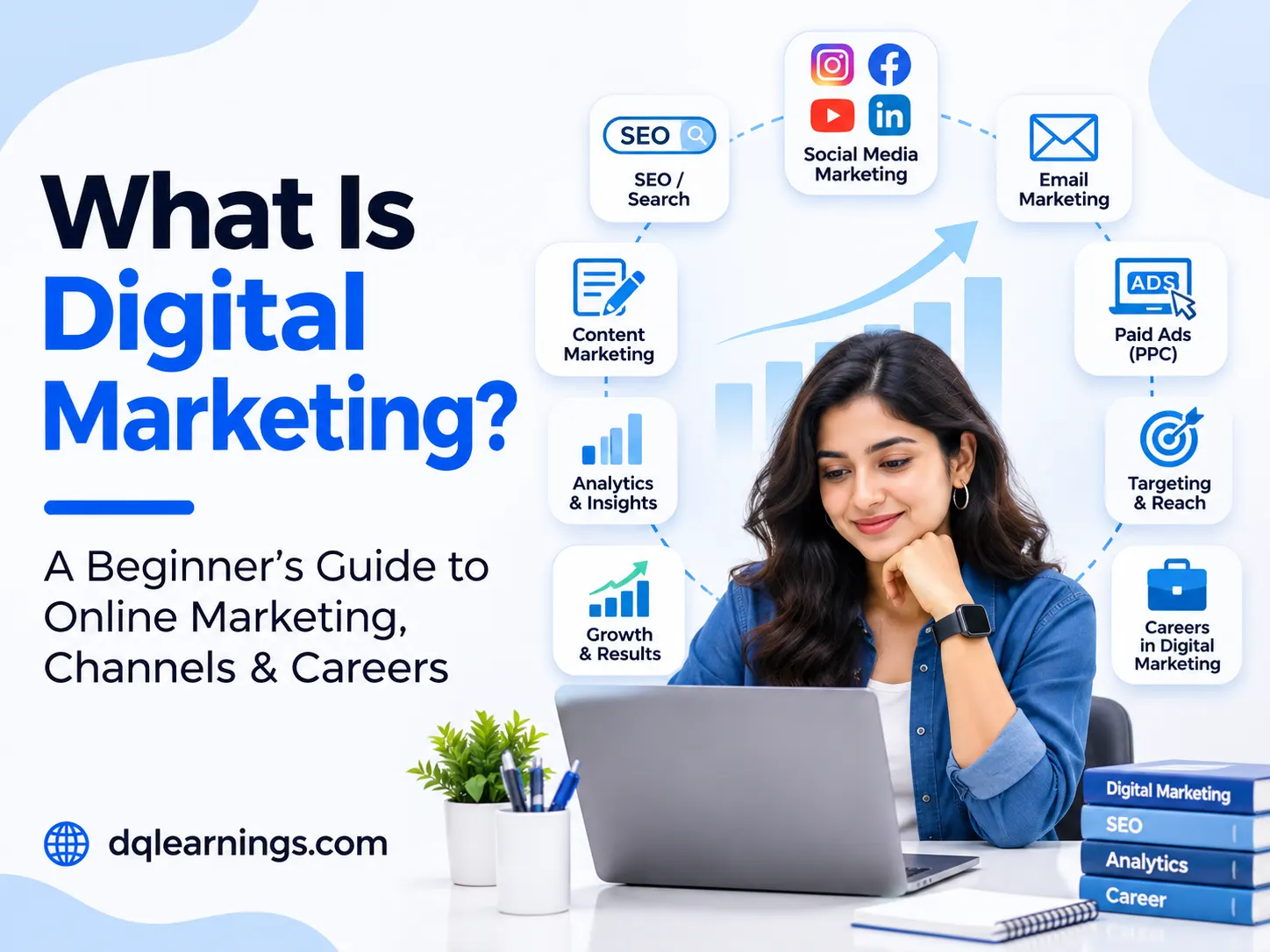
It includes areas such as search engine optimization, social media marketing, paid advertising, content marketing, email marketing, analytics, local marketing, and conversion optimization.
In this beginner-friendly guide, you will learn what digital marketing is, how it works, its major channels, important terminology, useful tools, career opportunities, required skills, and how you can start learning digital marketing step by step.
If you want structured practical training, you can also explore the Digital Marketing Course at DQ Learnings.
What Is Digital Marketing?
Digital marketing is the process of promoting a business, product, service, or brand through digital channels.
These channels can include:
- Search engines
- Websites
- Social media
- Mobile applications
- Online advertising
- Video platforms
- Digital marketplaces
The objective depends on the business.
Digital marketing may be used to:
- Increase brand awareness
- Generate website traffic
- Attract potential customers
- Generate leads
- Increase online sales
- Promote products or services
- Build customer relationships
- Retain existing customers
- Measure marketing performance
Unlike many traditional marketing methods, digital marketing allows businesses to measure user behaviour and campaign performance in greater detail.
What Is Online Marketing?
Online marketing generally refers to marketing activities that happen through internet-based channels.
Examples include:
- SEO
- Google Ads
- Social media marketing
- Email marketing
- Content marketing
- Influencer marketing
- Website marketing
The terms digital marketing and online marketing are often used interchangeably.
However, digital marketing can be understood more broadly because it may include digital technologies and channels beyond traditional web browsing.
For a beginner, the most important thing is understanding how different digital channels help businesses reach and influence customers.
How Does Digital Marketing Work?
Digital marketing usually starts with understanding the customer.
A business first needs to know:
- Who is the target audience?
- What does the audience need?
- What problems are they trying to solve?
- Where do they spend time online?
- What influences their buying decisions?
- What action does the business want them to take?
Once these questions are clear, marketers can select suitable channels.
For example:
A local dentist may focus on:
Local SEO + Google Ads + Reviews + Website
An e-commerce brand may focus on:
SEO + Shopping Ads + Meta Ads + Email + Retargeting
A B2B software company may focus on:
Content + SEO + LinkedIn + Email + Lead Generation
Digital marketing is therefore not about being present on every platform.
It is about selecting the right channels according to the audience, objective, budget, and customer journey.
Understanding the Digital Marketing Funnel
Customers do not always purchase immediately after seeing a brand for the first time.
They may move through several stages.
A simple digital marketing funnel can look like:
Awareness → Interest → Consideration → Conversion → Retention
Awareness
The customer becomes aware of the brand or problem.
Marketing activities may include:
- Social media
- SEO
- Display advertising
- Videos
- Influencer content
Interest
The customer begins exploring the solution.
They may:
- Visit the website
- Read articles
- Watch videos
- Follow the brand
- Compare options
Consideration
The customer evaluates whether the product or service is suitable.
Useful marketing assets may include:
- Reviews
- Case studies
- Testimonials
- Product comparisons
- Demonstrations
- Detailed landing pages
Conversion
The customer completes the desired action.
A conversion may be:
- Purchase
- Lead form
- Phone call
- Appointment
- Registration
- Demo request
- Course enrollment
Retention
After acquiring the customer, businesses can continue the relationship through:
- Customer support
- Loyalty programmes
- Remarketing
- Useful content
- Repeat purchase campaigns
Strong digital marketing considers the entire customer journey rather than focusing only on the first click.
Major Types of Digital Marketing
Digital marketing includes multiple specializations.
Beginners should first understand the major channels before choosing an area to specialize in.
Search Engine Optimization
Search Engine Optimization, or SEO, is the process of improving a website so that it can gain better visibility in organic search results.
For example, someone may search:
best digital marketing course
or:
English speaking course near me
Businesses optimize their websites to become more relevant and accessible for such searches.
SEO commonly includes:
- Keyword research
- Search intent
- On-page SEO
- Technical SEO
- Content optimization
- Internal linking
- Link building
- Local SEO
- Competitor research
Keyword Research
Keyword research helps marketers understand what people search for online.
Examples may include:
- digital marketing course
- best laptop for students
- dentist near me
- accounting software for small business
A marketer studies keywords to understand:
- Search demand
- User intent
- Topic opportunities
- Competition
On-Page SEO
On-page SEO involves optimizing individual website pages.
This can include:
- Page titles
- Headings
- Content
- URLs
- Internal links
- Images
- Meta descriptions
The objective is to make the page useful for users while helping search engines understand its topic.
Technical SEO
Technical SEO focuses on how easily search engines can access and understand a website.
Areas may include:
- Crawlability
- Indexing
- Website speed
- Mobile usability
- Site structure
- Canonicalization
- Structured data
Local SEO
Local SEO helps businesses appear for location-based searches.
Examples include:
- dentist in Haldwani
- café near me
- digital marketing institute in Haldwani
- hotel in Nainital
Local SEO can be particularly useful for:
- Clinics
- Restaurants
- Salons
- Institutes
- Hotels
- Local service providers
Search Engine Marketing
Search Engine Marketing often refers to using paid advertising to gain visibility on search engines.
Google Ads is one of the most common examples.
Businesses can advertise for searches related to their products or services.
For example:
A training institute may advertise for:
digital marketing course in Haldwani
A hotel may target:
hotel near Nainital lake
Paid search can help businesses reach users who are actively searching for a solution.
Pay Per Click Advertising
Pay Per Click, commonly known as PPC, is an advertising model where advertisers may pay when users click their ads.
Digital marketers working with PPC need to understand:
- Keywords
- Audiences
- Campaign structure
- Ad copy
- Landing pages
- Bidding
- Budget
- Conversion tracking
- CPC
- CPA
- ROAS
The goal should not simply be to generate clicks.
Successful performance marketing focuses on generating useful business outcomes.
Social Media Marketing
Social Media Marketing involves using social platforms to build awareness, communicate with audiences, and support business goals.
Platforms may include:
- YouTube
Activities can include:
- Content creation
- Reels
- Videos
- Community engagement
- Brand storytelling
- Social advertising
- Influencer collaborations
Good social media marketing is not simply about posting every day.
Content should have a purpose.
That purpose may be:
- Awareness
- Engagement
- Education
- Lead generation
- Sales
- Customer retention
Content Marketing
Content marketing involves creating valuable information for a specific audience.
Content may include:
- Blog posts
- Videos
- Guides
- Infographics
- Case studies
- Social media posts
- Podcasts
- Webinars
Good content helps answer customer questions and build trust.
For example, a digital marketing institute may create content around:
- What is SEO?
- How to start digital marketing?
- Digital marketing career opportunities
- How Google Ads works
The content attracts people already interested in the subject.
Email Marketing
Email marketing allows businesses to communicate directly with leads and customers.
Email campaigns may be used for:
- Newsletters
- Offers
- Product announcements
- Course updates
- Lead nurturing
- Customer retention
- Abandoned cart reminders
Important email marketing metrics may include:
- Delivery rate
- Open rate
- Click rate
- Conversion rate
- Unsubscribe rate
The objective is to send relevant communication rather than repeatedly sending promotional messages.
Video Marketing
Video is an important digital content format.
Businesses may use videos for:
- Product demonstrations
- Tutorials
- Testimonials
- Educational content
- Reels
- Brand stories
- Interviews
- Advertisements
Platforms such as YouTube and social media make video useful for both awareness and conversion.
Influencer Marketing
Influencer marketing involves collaborating with individuals who have an audience or credibility within a particular niche.
Influencers may help brands:
- Reach new audiences
- Build awareness
- Demonstrate products
- Generate engagement
- Support sales campaigns
A large follower count does not automatically mean an influencer is suitable.
Marketers should also consider:
- Audience relevance
- Engagement
- Content quality
- Brand fit
- Campaign objective
Affiliate Marketing
Affiliate marketing allows individuals or businesses to promote products and earn compensation when specific actions or sales are generated through tracked referrals.
The exact structure varies between programmes.
Affiliate marketing commonly involves:
Brand → Affiliate → Audience → Tracked Action → Commission
Mobile Marketing
Mobile marketing focuses on reaching users through mobile devices.
This may include:
- Mobile-friendly websites
- Mobile applications
- SMS
- Push notifications
- Mobile advertising
Because users frequently browse and purchase through smartphones, mobile experience is an important part of modern marketing.
Marketing Analytics
Digital marketing produces large amounts of data.
Analytics helps marketers understand what is working and what needs improvement.
Important metrics may include:
- Website traffic
- Impressions
- Clicks
- CTR
- CPC
- Leads
- Conversions
- Conversion rate
- CPA
- Revenue
- ROAS
The right metric depends on the business objective.
For example, a campaign designed for sales should not be judged only by likes.
Conversion Rate Optimization
Conversion Rate Optimization, or CRO, focuses on improving the percentage of users who complete a desired action.
Possible conversions include:
- Purchase
- Form submission
- Call
- Registration
- Download
- Appointment booking
CRO may involve improving:
- Headlines
- Landing pages
- Forms
- Calls to action
- Page layout
- Offers
- Website speed
- User experience
Generating more traffic is not always necessary if you can convert existing traffic more effectively.
Marketing Automation
Marketing automation uses technology to automate selected repetitive marketing activities.
Examples may include:
- Email sequences
- Lead follow-ups
- Customer segmentation
- CRM workflows
- Campaign triggers
- Reporting
Automation can improve efficiency, but it should support a clear marketing strategy rather than replace it.
AI in Digital Marketing
Artificial intelligence is increasingly being used to support digital marketing workflows.
Marketers may use AI for:
- Research
- Content ideation
- Drafting
- Data analysis
- Audience insights
- Creative assistance
- Automation
- Campaign analysis
However, AI does not eliminate the need for marketing fundamentals.
Marketers still need to understand:
- Customers
- Positioning
- Search intent
- Brand communication
- Campaign objectives
- Data
- Conversion
Learners interested in going deeper into AI-assisted marketing can also explore the Digital Marketing with Advanced AI Course.
Organic Marketing vs Paid Marketing
Beginners often confuse organic and paid marketing.
| Factor | Organic Marketing | Paid Marketing |
|---|---|---|
| Traffic Source | Unpaid visibility | Paid advertising |
| Examples | SEO, organic social, content | Google Ads, Meta Ads |
| Initial Speed | Usually gradual | Can start quickly after launch |
| Budget | Requires time and resources | Requires advertising budget |
| Long-Term Value | Can continue generating visibility | Usually depends on ongoing spend |
| Best Use | Building sustainable visibility | Reaching targeted users quickly |
Most businesses can benefit from combining both approaches according to their goals.
SEO vs Google Ads
SEO and Google Ads both help businesses gain visibility in search, but they work differently.
| Factor | SEO | Google Ads |
|---|---|---|
| Placement | Organic search results | Paid placements |
| Payment Per Click | No direct payment for organic clicks | Advertising cost applies |
| Speed | Usually gradual | Can generate visibility quickly |
| Long-Term Value | Can build over time | Depends on campaign budget |
| Main Focus | Organic relevance and authority | Paid targeting and bidding |
One is not automatically better than the other.
Businesses often use both.
Traditional Marketing vs Digital Marketing
Traditional and digital marketing can both be useful.
| Traditional Marketing | Digital Marketing |
|---|---|
| Newspapers | Search engines |
| Television | YouTube |
| Radio | Podcasts |
| Billboards | Display ads |
| Flyers | Email campaigns |
| Physical events | Webinars |
Digital marketing provides additional opportunities for:
- Audience targeting
- Campaign measurement
- Performance tracking
- Personalization
- Testing
- Optimization
Businesses can combine traditional and digital channels depending on their audience.
Important Digital Marketing Metrics
Beginners should learn how to interpret basic metrics.
Impressions
Impressions indicate how many times content or an advertisement was shown.
Reach
Reach generally refers to the number of unique users who saw the content.
Click-Through Rate
CTR measures the percentage of impressions that resulted in clicks.
CTR = Clicks / Impressions × 100
Cost Per Click
CPC shows the average amount spent for each advertising click.
CPC = Advertising Spend / Clicks
Conversion Rate
Conversion rate measures how many users completed the desired action.
Conversion Rate = Conversions / Visitors or Clicks × 100
Cost Per Acquisition
CPA measures how much it costs to generate a desired conversion.
CPA = Advertising Cost / Conversions
Return on Ad Spend
ROAS compares attributed advertising revenue with advertising spend.
ROAS = Ad Revenue / Ad Spend
Metrics should always be interpreted according to the business goal.
Common Digital Marketing Tools
Digital marketers often use different tools depending on their specialization.
| Area | Common Tool Type |
|---|---|
| SEO | Keyword research and search performance tools |
| Analytics | Website and campaign analytics |
| Paid Advertising | Search and social ad platforms |
| Social Media | Scheduling and analytics tools |
| Content | Writing, design and research tools |
| Email campaign platforms | |
| CRM | Lead and customer management systems |
| Design | Graphic and video creation tools |
| AI | Research, ideation and workflow tools |
Tools change frequently.
Understanding the marketing principle behind the tool is more important than memorizing one interface.
What Skills Does a Digital Marketer Need?
Digital marketing combines technical, analytical, creative, and communication skills.
Useful skills include:
- Marketing fundamentals
- Customer understanding
- SEO
- Content strategy
- Social media
- Paid advertising
- Analytics
- Communication
- Copywriting
- Research
- Problem solving
- Basic design understanding
You do not need to master every skill immediately.
Start with the fundamentals and gradually specialize.
Analytical Skills
Digital marketers need to interpret campaign data.
They should be able to ask:
- Why did traffic increase?
- Why did conversions decrease?
- Which campaign produced better leads?
- Which content performed best?
- Where are users leaving the funnel?
Data should help guide decisions.
Communication Skills
Digital marketers communicate with:
- Customers
- Clients
- Designers
- Developers
- Sales teams
- Managers
- Content creators
Clear communication helps turn strategies into action.
Creativity
Marketing also requires creativity.
You may need to develop:
- Campaign ideas
- Headlines
- Social content
- Advertisements
- Video concepts
- Offers
Creativity should support the marketing objective rather than exist only for visual appeal.
Research Skills
Good marketers regularly research:
- Customers
- Competitors
- Keywords
- Industries
- Trends
- Campaign performance
Strong research improves decision making.
Career Opportunities in Digital Marketing
Digital marketing includes many career paths.
Possible entry-level and specialized roles include:
- Digital Marketing Executive
- SEO Executive
- SEO Specialist
- Social Media Executive
- Social Media Manager
- Content Marketer
- PPC Executive
- Performance Marketer
- Email Marketing Executive
- Marketing Analyst
- Digital Marketing Manager
Professionals can also work as:
- Freelancer
- Consultant
- Agency professional
- In-house marketer
- Entrepreneur
Your career path depends on your skills, interests, experience, and specialization.
Digital Marketing Executive
A Digital Marketing Executive may work across several channels.
Responsibilities can include:
- SEO
- Content
- Social media
- Ads
- Analytics
- Reporting
This can be a useful starting role for beginners who want exposure to multiple areas.
SEO Specialist
SEO specialists focus on organic search visibility.
Their work may include:
- Keyword research
- Website audits
- Content optimization
- Technical SEO
- Link building
- Search performance analysis
Social Media Manager
Social media professionals manage brand communication across social platforms.
Responsibilities may include:
- Content planning
- Community engagement
- Campaigns
- Reporting
- Creative coordination
Performance Marketer
Performance marketers focus heavily on measurable campaign results.
They may work with:
- Google Ads
- Meta Ads
- Landing pages
- Conversion tracking
- Budgets
- CPA
- ROAS
Content Marketer
Content marketers plan and create content that supports business objectives.
Their work may involve:
- Blog strategy
- Website content
- Social content
- Video ideas
- Lead-generation content
Who Can Learn Digital Marketing?
Digital marketing can be learned by people from many educational backgrounds.
It may be suitable for:
- Students
- Fresh graduates
- Working professionals
- Business owners
- Freelancers
- Content creators
- Entrepreneurs
- Career switchers
A technical degree is not compulsory for understanding digital marketing fundamentals.
Your willingness to learn, practise, analyse, and adapt is important.
Digital Marketing for Students
Students can use digital marketing skills to:
- Build practical projects
- Explore internships
- Develop portfolios
- Understand online businesses
- Prepare for marketing careers
Starting early can provide more time to experiment with different specializations.
Digital Marketing for Business Owners
Business owners can learn digital marketing to better understand:
- Customer acquisition
- Search visibility
- Social media
- Advertising
- Lead generation
- Analytics
Even if a business later hires a marketer or agency, basic knowledge can help owners evaluate marketing performance.
Digital Marketing for Freelancers
Freelancers may offer services such as:
- SEO
- Social media management
- Content marketing
- Google Ads
- Meta Ads
- Analytics
- Website optimization
Freelancing also requires:
- Client communication
- Sales
- Reporting
- Time management
- Project management
Technical knowledge alone is not enough.
How to Start Learning Digital Marketing
Beginners often become overwhelmed because there are too many topics.
A structured approach makes learning easier.
Understand Marketing Fundamentals
Before learning every tool, understand:
- Customers
- Segmentation
- Positioning
- Marketing objectives
- Customer journeys
- Funnels
Digital tools become easier to use when you understand why they are being used.
Learn How Websites Work
Understand basic concepts such as:
- Domains
- Hosting
- Web pages
- Landing pages
- URLs
- Forms
- Content management systems
A website often acts as the central destination for digital campaigns.
Learn SEO Basics
Start with:
- Keywords
- Search intent
- On-page SEO
- Content
- Internal linking
- Technical basics
- Local SEO
Then practise by optimizing actual or sample pages.
Learn Social Media Marketing
Understand:
- Platform differences
- Audience behaviour
- Content formats
- Content calendars
- Engagement
- Metrics
Avoid focusing only on follower counts.
Learn Paid Advertising Basics
Understand:
- Campaign objectives
- Targeting
- Budget
- Creative
- Landing pages
- Conversion tracking
- CPC
- CPA
Start with campaign planning before focusing deeply on platform controls.
Learn Analytics
Learn how to interpret basic data.
Ask:
- Where is traffic coming from?
- What are users doing?
- Which pages perform well?
- Which campaigns produce conversions?
Analytics connects marketing activity with results.
Work on Practical Projects
Theory alone is not enough.
Create practical projects such as:
- SEO audit
- Keyword research
- Content calendar
- Social media strategy
- Google Ads campaign plan
- Landing page
- Analytics report
- Competitor analysis
Projects help turn knowledge into usable skills.
The Digital Marketing Course at DQ Learnings can also be explored if you prefer a structured learning path with practical application.
Build a Digital Marketing Portfolio
A beginner portfolio can include:
- SEO audit
- Keyword strategy
- Website analysis
- Social media plan
- Sample ad campaigns
- Content strategy
- Performance report
- Case study
You do not always need paid client work to begin building a portfolio.
You can create sample projects for fictional or real businesses and clearly label them as practice work.
Common Digital Marketing Mistakes Beginners Make
| Mistake | Why It Causes Problems | Better Approach |
|---|---|---|
| Learning every tool at once | Creates confusion | Build fundamentals first |
| Focusing only on social media | Limits your understanding | Learn multiple core channels |
| Ignoring analytics | Results cannot be evaluated | Track meaningful metrics |
| Chasing followers | Followers may not generate business | Focus on objectives |
| Running ads without tracking | Performance becomes unclear | Set up conversion measurement |
| Copying competitors | Strategy lacks differentiation | Understand customer needs |
| Collecting certificates only | Knowledge remains theoretical | Build practical projects |
| Ignoring customer intent | Content becomes irrelevant | Start with audience research |
A Beginner Digital Marketing Roadmap
| Stage | Main Focus |
|---|---|
| Marketing Fundamentals | Audience, positioning and customer journey |
| Website Basics | Pages, landing pages and forms |
| SEO | Search intent, keywords and optimization |
| Content | Blogs, social and communication |
| Paid Media | Google and social advertising basics |
| Analytics | Traffic, conversions and campaign metrics |
| Practical Work | Projects and campaign simulations |
| Portfolio | Evidence of practical skills |
| Specialization | Choose an area for deeper learning |
Follow the roadmap gradually instead of trying to master everything in a few days.
How Long Does It Take to Learn Digital Marketing?
There is no fixed timeline.
The time required depends on:
- Current knowledge
- Amount of daily practice
- Learning method
- Number of channels studied
- Practical experience
- Career goal
A beginner can understand basic concepts relatively quickly, but becoming confident in planning and executing campaigns requires practice.
Digital marketing should be treated as an ongoing learning process because platforms, tools, and customer behaviour continue to change.
Is Digital Marketing Difficult for Beginners?
Digital marketing can initially seem complicated because it includes many areas.
You may encounter terms such as:
- SEO
- PPC
- CTR
- CPC
- CPA
- ROAS
- Conversion
- Funnel
- Remarketing
Do not try to memorize everything immediately.
Learn one concept at a time and connect it with practical examples.
A useful learning process is:
Understand → Practice → Analyze → Improve
Does Digital Marketing Require Coding?
Most digital marketing roles do not require you to become a professional programmer.
However, basic technical understanding can be useful for areas such as:
- Website management
- SEO
- Tracking
- Analytics
- Landing pages
The technical depth required depends on your specialization.
Is Digital Marketing a Good Career for Beginners?
Digital marketing offers multiple career paths and allows learners to specialize according to their interests.
Someone interested in writing may move toward content marketing.
Someone who enjoys data may prefer analytics or performance marketing.
Someone interested in search may focus on SEO.
Someone who enjoys social platforms may move toward social media marketing.
The most important step is building practical capability rather than choosing a specialization only because it seems popular.
Frequently Asked Questions About Digital Marketing
What is digital marketing in simple words?
Digital marketing means using online and digital channels to promote a business, product, service, or brand and communicate with potential customers.
What are the main types of digital marketing?
Major areas include SEO, paid advertising, social media marketing, content marketing, email marketing, analytics, video marketing, influencer marketing, and conversion optimization.
Is SEO part of digital marketing?
Yes
SEO is one of the major digital marketing channels focused on improving organic search visibility.
Is social media marketing the same as digital marketing?
No
Social media marketing is one part of digital marketing.
Digital marketing also includes areas such as SEO, paid advertising, email, content, analytics, and websites.
Can beginners learn digital marketing?
Yes
Beginners can start with marketing fundamentals and gradually learn SEO, content, social media, paid advertising, and analytics.
Do I need a marketing degree to learn digital marketing?
A marketing degree can be helpful but is not necessary for learning practical digital marketing skills.
Learners from different educational backgrounds can build digital marketing capabilities through structured learning and practice.
Can digital marketing be done without paid ads?
Yes
Businesses can use organic channels such as SEO, content marketing, organic social media, and email.
Paid advertising can be added depending on business goals and budget.
What skills should a beginner learn first?
A useful starting combination includes:
- Marketing fundamentals
- Customer understanding
- Website basics
- SEO
- Content
- Social media
- Paid advertising basics
- Analytics
Is AI replacing digital marketers?
AI can assist marketers with research, ideation, analysis, automation, and content workflows.
However, marketers still need to understand strategy, customers, positioning, communication, data, and business objectives.
Where can I learn digital marketing?
You can learn through self-study, practical projects, online resources, or structured training.
If you prefer guided learning, explore the Digital Marketing Course at DQ Learnings.
Digital Marketing Beginner Checklist
Use this checklist to evaluate your foundation:
- I understand basic marketing concepts
- I understand customer journeys
- I know what SEO is
- I understand social media marketing
- I understand paid advertising basics
- I know the role of content marketing
- I understand basic analytics metrics
- I know what conversion tracking means
- I understand the difference between organic and paid marketing
- I have completed at least one practical project
- I can explain how different marketing channels work together
- I understand that marketing decisions should connect with business objectives
You do not need to master everything before moving forward.
Use the checklist to identify areas that require more practice.
Conclusion
Digital marketing uses digital channels, technology, content, and data to connect businesses with customers and achieve marketing objectives.
It includes several interconnected areas:
Strategy → Website → SEO → Content → Social Media → Paid Advertising → Analytics → Conversion
Beginners should avoid treating these channels as completely separate subjects.
A strong digital marketer understands how they work together.
Start with marketing fundamentals and customer understanding.
Then learn website basics, SEO, content, social media, paid advertising, and analytics.
Most importantly, practise what you learn.
Create projects, analyse websites, plan campaigns, perform keyword research, build content strategies, and review performance data.
Digital marketing becomes easier when you move from simply learning definitions to understanding how marketing activities solve real business problems.
If you want a structured, practical path, explore the Digital Marketing Course at DQ Learnings to build a foundation across strategy, search, content, paid media, analytics, and practical digital marketing work.