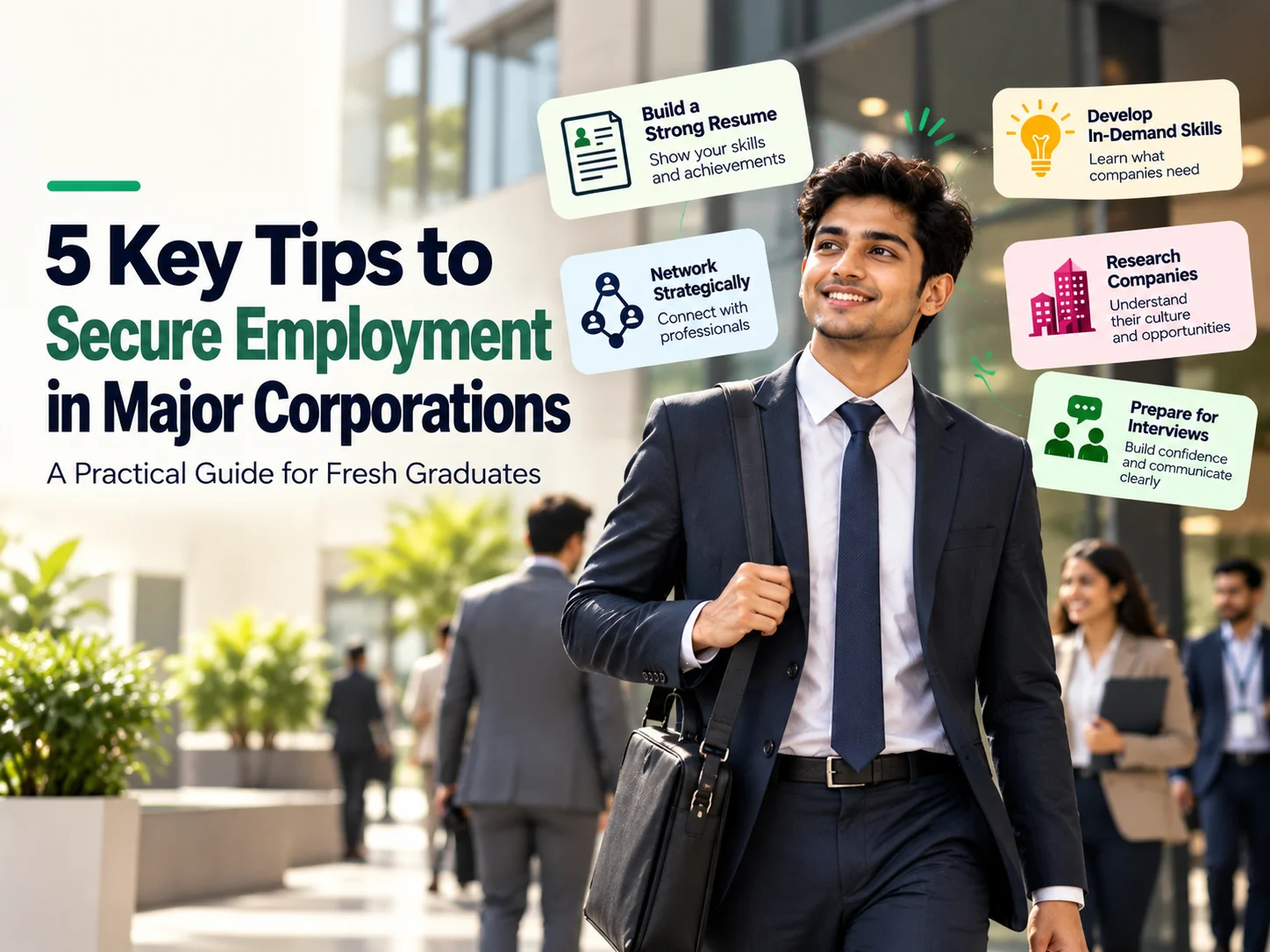
Entering the job market as a fresh graduate can feel challenging. Competition is high, employers have specific expectations, and many candidates are trying to prove their value without having years of professional experience.
Securing employment in a major corporation can provide valuable exposure, structured learning, career growth, professional networks, and opportunities to work on large-scale projects.
However, getting hired by a well-established organization usually requires more than submitting a resume and waiting for an interview call.
Fresh graduates need to understand how corporate hiring works, develop relevant skills, build a professional presence, network strategically, and prepare carefully for interviews.
This guide explains practical strategies that can help fresh graduates secure employment in major corporations and become better prepared for competitive hiring processes.
If you are currently developing professional skills for your first job, you can also explore the Courses at DQ Learnings for career-focused learning options.
Understand the Corporate Mindset
One of the biggest differences between campus life and corporate life is the way responsibilities, communication, and performance are handled.
Companies generally expect employees to demonstrate:
- Professionalism
- Accountability
- Reliability
- Communication skills
- Problem-solving ability
- Adaptability
- Teamwork
- Willingness to learn
Fresh graduates may not have extensive work experience, but they can still demonstrate these qualities during the hiring process.
Research the Company Before Applying
Avoid applying to companies without understanding what they do.
Before submitting an application, research:
- Company products and services
- Industry
- Business model
- Recent news
- Company culture
- Major achievements
- Competitors
- Job requirements
This research helps you understand whether the opportunity matches your career goals.
It also helps you prepare better answers during interviews.
For example, instead of saying:
"I want to work here because this is a good company"
you can explain:
"I am interested in this role because your company works extensively in digital transformation, and I want to build practical experience in technology-driven projects"
Specific answers generally demonstrate stronger preparation.
Understand the Job Description
Many candidates apply based only on the job title.
Instead, read the complete job description carefully.
Identify:
- Required skills
- Preferred skills
- Software or tools
- Communication requirements
- Educational qualifications
- Responsibilities
- Experience expectations
Create a simple comparison:
| Requirement | Your Current Level | Action Needed |
|---|---|---|
| Communication | Intermediate | Improve interview speaking |
| Excel | Basic | Learn formulas and reporting |
| Industry knowledge | Basic | Research sector |
| Presentation | Intermediate | Practice more |
| Relevant tools | Beginner | Complete practical training |
This helps you prepare specifically for the job instead of learning random skills.
Stay Updated With Industry Trends
Major corporations often prefer candidates who understand what is happening in their industry.
Depending on your career field, follow:
- Industry news
- Company announcements
- New technologies
- Market changes
- Business trends
- Regulatory changes
- Emerging job roles
For example, digital marketing candidates should understand developments in:
- SEO
- Artificial intelligence
- Social media
- Paid advertising
- Analytics
- Automation
Technology candidates may need to follow areas such as:
- Cloud computing
- Cybersecurity
- Artificial intelligence
- Software development
- Data engineering
Industry awareness can help you speak more confidently during interviews.
Build a Strong Personal Brand
Your personal brand is the professional impression people develop when they see your resume, LinkedIn profile, portfolio, projects, and online presence.
For fresh graduates, a strong personal brand can help compensate for limited work experience.
Your professional profile should communicate:
Who you are + What you know + What you have done + What you want to do
Optimize Your Resume
Your resume is often the first interaction you have with a recruiter.
Keep it:
- Clear
- Relevant
- Concise
- Easy to scan
- Tailored to the role
Avoid filling the resume with unnecessary information.
Prioritize:
- Education
- Relevant skills
- Internships
- Certifications
- Projects
- Achievements
- Volunteer experience
- Relevant extracurricular activities
Focus on Achievements Instead of Responsibilities
Where possible, explain what you actually accomplished.
Instead of:
"Worked on social media"
write:
"Created and scheduled social media content for a college campaign across Instagram and LinkedIn"
Instead of:
"Participated in college event"
write:
"Coordinated a five-member team responsible for marketing and registrations for a college event"
Action-oriented descriptions help recruiters understand your contribution.
Useful action words include:
- Developed
- Created
- Coordinated
- Improved
- Managed
- Analyzed
- Designed
- Organized
- Researched
- Implemented
Tailor Your Resume for Each Job
Avoid sending exactly the same resume everywhere.
If one role emphasizes:
SEO + Analytics
highlight relevant SEO projects, certifications, and analytics exposure.
If another role focuses on:
Social Media + Content
prioritize related skills and projects.
Tailoring does not mean changing facts.
It means showing the most relevant information for each opportunity.
Optimize Your LinkedIn Profile
LinkedIn can be particularly useful for corporate job searches.
A strong profile should include:
- Professional profile photo
- Clear headline
- Strong About section
- Education
- Skills
- Certifications
- Projects
- Internships
- Relevant experience
Your headline should communicate more than:
Student at XYZ College
A stronger version might be:
Marketing Graduate | SEO & Digital Marketing Learner | Open to Entry-Level Opportunities
This immediately tells recruiters what direction you are pursuing.
Build a Professional Online Presence
Depending on your field, you can also build:
- Portfolio website
- GitHub profile
- Behance portfolio
- Personal projects
- Professional content
- Case studies
For example, a digital marketing candidate can create:
- SEO audit
- Social media strategy
- Keyword research project
- Google Ads campaign plan
- Content calendar
Practical work gives recruiters something concrete to evaluate.
Acquire Relevant Skills and Certifications
Fresh graduates may lack full-time work experience, but practical skills can help bridge that gap.
The goal should not be to collect as many certificates as possible.
Focus on developing skills that are relevant to your target role.
Learn Industry-Relevant Technical Skills
Different careers require different technical capabilities.
| Career Area | Useful Skills |
|---|---|
| Digital Marketing | SEO, social media, Google Ads, analytics |
| Finance | Excel, accounting software, financial analysis |
| Software Development | Programming, Git, testing, cloud basics |
| Design | Figma, Adobe tools, prototyping |
| Data Analytics | Excel, SQL, visualization tools |
| Sales | CRM, communication, reporting |
Choose skills based on the jobs you want to apply for.
Develop Digital Skills
Digital literacy is becoming increasingly important across industries.
Basic workplace tools may include:
- Microsoft Excel
- Microsoft Word
- PowerPoint
- Google Workspace
- Video conferencing tools
- Collaboration platforms
Even candidates applying for non-technical roles often need to work comfortably with digital tools.
Improve Communication Skills
Communication is one of the most important skills for corporate employment.
You may need to communicate through:
- Interviews
- Emails
- Meetings
- Presentations
- Team discussions
- Client calls
If you understand English but hesitate while speaking, structured practice can improve your confidence.
You can explore the English Speaking Course at DQ Learnings for practical speaking, interview, presentation, and workplace communication practice.
Develop Soft Skills
Corporations also evaluate how effectively you work with people.
Important soft skills include:
- Communication
- Time management
- Adaptability
- Teamwork
- Critical thinking
- Problem solving
- Emotional maturity
You can build these skills through:
- Group projects
- Internships
- College activities
- Volunteer projects
- Freelance work
- Competitions
Choose Certifications Strategically
Certifications can support your resume when they align with your career goal.
Before enrolling, ask:
- Is this skill relevant to my target job?
- Will I gain practical experience?
- Can I demonstrate what I learned?
- Will it strengthen my portfolio?
One relevant certification with practical projects can be more valuable than multiple unrelated certificates.
Network Strategically
Networking is one of the most useful strategies for discovering opportunities.
Networking does not mean asking strangers directly for jobs.
It means building professional relationships and learning from people in your target industry.
Start With Your Alumni Network
Your college alumni can be valuable connections because you already share a common background.
Find alumni working in:
- Target companies
- Target industries
- Relevant job roles
Instead of sending:
"Hi, please refer me for a job"
send something more professional:
"Hi, I noticed that you graduated from the same college and currently work in digital marketing. I'm preparing for entry-level roles in this field and would appreciate any advice you can share about the skills companies usually look for"
This creates a more natural conversation.
Attend Career Fairs
Career fairs provide direct access to recruiters and company representatives.
Before attending:
- Research participating companies
- Prepare your resume
- Practice your introduction
- Identify relevant openings
- Prepare useful questions
A simple introduction could include:
Name + Education + Skills + Career Interest
Keep it short and confident.
Attend Industry Events
Industry events, workshops, seminars, webinars, and conferences can help you:
- Learn about current trends
- Meet professionals
- Understand career opportunities
- Discover companies
- Build connections
After meeting someone, connect on LinkedIn with a personalized message.
Use LinkedIn Strategically
Do more than create a profile and wait.
You can:
- Follow target companies
- Follow recruiters
- Connect with professionals
- Comment thoughtfully on relevant posts
- Share projects
- Share industry insights
- Engage with professional communities
Regular professional activity can increase your visibility.
Ask for Referrals Professionally
Employee referrals can be useful, but avoid asking everyone immediately.
Build some context first.
Before requesting a referral:
- Check whether the position matches your profile
- Review the job description carefully
- Ensure your resume is relevant
- Approach the person professionally
- Make the request easy to understand
Never pressure someone to refer you.
A referral can help your application get noticed, but your skills and interview performance still matter.
Master the Interview Process
Getting shortlisted is only one stage.
The interview is where you demonstrate whether you can perform the role and fit into the organization.
Research the Company
Before the interview, understand:
- What the company does
- Key products or services
- Target customers
- Industry
- Competitors
- Recent developments
- Company values
You should be able to answer:
"Why do you want to work here?"
without giving a generic response.
Understand the Role
Read the job description again before the interview.
Think about:
- Which skills they need
- Which projects you can discuss
- Which experiences demonstrate those skills
- What questions they might ask
Prepare examples from:
- College projects
- Internships
- Freelance work
- Competitions
- Volunteer experiences
- Certifications
Fresh graduates can use academic and personal projects when professional experience is limited.
Practice Common Interview Questions
Prepare for questions such as:
- Tell me about yourself
- Why do you want to work here?
- Why should we hire you?
- What are your strengths?
- What is one area you want to improve?
- Tell me about a challenge you faced
- Where do you see yourself in the future?
- Tell me about a project you worked on
Avoid memorizing every answer word for word.
Understand your key points and speak naturally.
Use the STAR Method
For behavioural questions, the STAR framework can help structure your response.
Situation — Explain the context
Task — Describe your responsibility
Action — Explain what you did
Result — Describe the outcome
For example:
Question: Tell me about a time you handled a difficult deadline
Instead of giving a vague answer, explain a specific situation and how you managed it.
This makes your response more credible.
Ask Thoughtful Questions
An interview is also an opportunity to learn about the role.
You can ask:
- What would success look like in this role during the first few months?
- What type of projects would I initially work on?
- How is performance evaluated?
- What learning opportunities are available?
- What does the team structure look like?
Avoid asking questions whose answers are clearly available on the company's homepage.
Improve Your Interview Communication
You do not need to use complicated English to impress an interviewer.
Focus on:
- Clear answers
- Good listening
- Professional tone
- Confidence
- Relevant examples
- Natural communication
Speaking clearly is more valuable than using difficult vocabulary incorrectly.
Follow Up Professionally
After the interview, a short thank-you message can reinforce professionalism.
Keep it brief.
For example:
"Thank you for taking the time to speak with me today. I enjoyed learning more about the role and the team and appreciate the opportunity to interview"
Avoid repeatedly contacting recruiters immediately after the interview.
Stay Resilient During Your Job Search
Even strong candidates may receive rejections.
Job searches are influenced by many factors:
- Number of applicants
- Hiring budgets
- Experience requirements
- Internal candidates
- Role changes
- Timing
A rejection does not automatically mean you lack ability.
Use each application as an opportunity to improve.
Track Your Applications
Maintain a simple job-search tracker.
| Company | Role | Application Date | Status | Follow-Up |
|---|---|---|---|---|
| Company A | Marketing Executive | 5 Oct | Applied | 10 Oct |
| Company B | SEO Executive | 7 Oct | Interview | Waiting |
| Company C | Graduate Trainee | 9 Oct | Applied | 14 Oct |
Tracking prevents confusion when you apply to multiple companies.
Review Your Job Search Strategy
If you apply to many jobs without getting interviews, review:
- Resume quality
- Role relevance
- Skills match
- Keywords
- Application strategy
If you receive interviews but no offers, focus more on:
- Interview communication
- Technical preparation
- Examples
- Confidence
- Company research
Identify where the process is breaking down.
Build Practical Experience While Applying
Do not stop learning while searching for jobs.
Continue working on:
- Personal projects
- Certifications
- Freelance projects
- Volunteer work
- Internships
- Industry research
This helps prevent career gaps from becoming completely inactive periods.
Keep Improving After Rejection
After each interview, ask yourself:
- Which questions did I struggle with?
- Was my introduction clear?
- Did I explain my projects properly?
- Did I research the company enough?
- Did I communicate confidently?
- Which technical areas need improvement?
Use the answers to prepare for the next opportunity.
Fresh Graduate Corporate Job Checklist
Before applying to major corporations, check whether:
- My resume is updated
- My resume matches the job role
- My LinkedIn profile is complete
- I understand the company's business
- I understand the job description
- I have relevant practical skills
- I can explain my projects
- I have practised interview questions
- I can communicate professionally
- I have examples of teamwork and problem solving
- I am actively networking
- I follow industry trends
- I continue learning while applying
You do not need to be perfect in every area before applying.
Use this checklist to identify what you should improve next.
A Simple Roadmap for Fresh Graduates
| Stage | Main Focus |
|---|---|
| Career Direction | Identify target roles and industries |
| Skill Development | Learn role-specific and professional skills |
| Personal Branding | Build resume, LinkedIn, and portfolio |
| Networking | Connect with alumni, recruiters, and professionals |
| Applications | Apply strategically to relevant jobs |
| Interview Preparation | Practice technical and behavioural questions |
| Continuous Improvement | Learn from feedback and keep building skills |
Following a structured process can make job searching less confusing and more focused.
Conclusion
Securing employment in major corporations as a fresh graduate requires more than simply having a degree.
You need to combine:
Skills + Personal Branding + Networking + Interview Preparation + Persistence
Start by understanding what companies expect and identifying the skills required for your target role.
Build practical experience, strengthen your resume, optimize your LinkedIn profile, and develop professional communication skills.
Network with alumni and industry professionals, prepare carefully for interviews, and continue improving even when applications do not immediately result in offers.
Most importantly, remain consistent.
Every project, application, interview, professional connection, and new skill contributes to your development.
The objective is not only to secure employment in major corporations, but to become the type of professional that companies want to hire and develop over the long term.
If you want to improve job-ready skills before entering the corporate world, explore the Courses at DQ Learnings and choose training aligned with your career goals.